Lighter content and pages
Review images, videos, files and components to limit unnecessary data transfers. Preserve the information and quality of the user experience.

Digital sustainability
We help assess what your project needs and where it can improve. Performance, maintenance and resource use are part of that analysis.
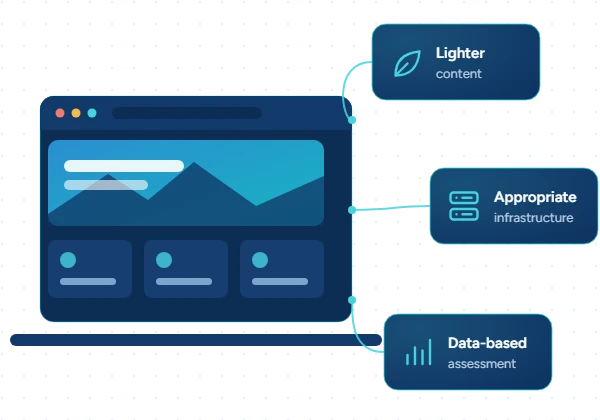
Our approach
A digital solution should address a specific need and remain useful over time. Our approach starts with the company's objectives, conditions of use and available resources.
We propose improvements appropriate to the project and planned investment. The proposal sets out the work, validation criteria and, where applicable, ongoing support. Results depend on the measures adopted and actual use.
Infrastructure and energy
Digital services rely on equipment, networks and data centres. The energy used by this infrastructure contributes to their environmental impact.
Vectweb’s servers are hosted in ONI’s Lisbon (Matinha) data centre. According to the provider’s public information, its data centres use 100% renewable electricity, with traceability through Greenchain technology.
Source: ONI Colocation Center · Accessed: 13 October 2026 · Public information from the provider; 2026 electricity consumption certificates have not been verified.
Practices
We select the relevant practices for each project. Implementation depends on the agreed scope.
Review images, videos, files and components to limit unnecessary data transfers. Preserve the information and quality of the user experience.
Organise information and make essential tasks easier. Include keyboard use and access on different devices in the validation criteria.
Review duplicate and outdated information. Agree what to retain, archive or remove, with attention to business needs and applicable obligations.
Assess capacity, operation and continuity requirements. Consider verifiable information from suppliers about energy and resources, where available.
Plan maintenance and documentation to keep the solution useful. Assess whether existing components can be reused before deciding to replace them.
Assess suitability for the process, the resources required, errors and the effort involved in human review. Efficiency requires comparison with the initial situation.
Each improvement must preserve security, service continuity and the tasks carried out by those who use the solution.
Evaluation
When the project includes improvement objectives, we agree the indicators and comparison method before implementation.
Select representative pages or processes and record available data. Identify conditions that affect comparisons.
Define measures, investment, owners and acceptance criteria. Start with improvements that are useful to your company.
Repeat the assessment under comparable conditions, check results and record limitations. Define whether adjustments or ongoing support are needed.
Less data transferred or a shorter execution time are technical indicators. A conclusion about energy or emissions requires its own data and methodology.
Indicators
We choose indicators according to the planned improvement and the data that can be obtained.
Data transferred on selected pages, performance and completion of essential tasks.
Time per task, errors, repetitions and review effort, with the workload recorded.
Storage and resource use; energy consumption only where suitable data is available.
If environmental estimates are provided, we identify the method, scope, period and limitations. We also compare changes in total usage volume.
Connection to our services
Digital sustainability can inform improvements to an existing project or criteria for a new one.
Review content, performance and user journeys.
Assess processes and the conditions for useful automation.
Review infrastructure and continuity needs.
Identify priorities and prepare an improvement plan.
Communication
We present proposed measures and the results that the data supports. Conclusions should state the context and limits of the evaluation.
Frequently asked questions
Yes. The analysis may identify improvements to content, features or hosting conditions. Feasibility and investment depend on the website's condition and the access available.
Speed alone does not determine emissions. An environmental assessment depends on the resources used, energy, infrastructure and scope considered. A technical improvement can be useful without allowing a reduction in emissions to be quantified.
It depends on the case. We compare the initial process with the proposed solution, the resources required and the review effort. Operational gains and environmental effects need assessments suited to each objective.
The decision depends on existing needs and conditions. We can propose improvements to the current solution. Replacement requires an assessment of benefits, costs and service continuity.
This page describes our working approach. Certification or external verification requires its own scope and an appropriate body, with a separate assessment and agreement.
Tell us about the website, application or process you would like to assess and your objectives. We define the information required and the next step. The proposal sets out the scope and conditions of the analysis.
We do not claim that our hosting has zero carbon emissions. ONI’s public information concerns the renewable source of the electricity used by its data centres. The impact of a digital service also depends on equipment, networks and other resources used in its operation.
Talk to us about your website or processes. We can help define the priorities.